System Design Phase 1 — Part 7: Message Queues & Async
📚 Table of Contents
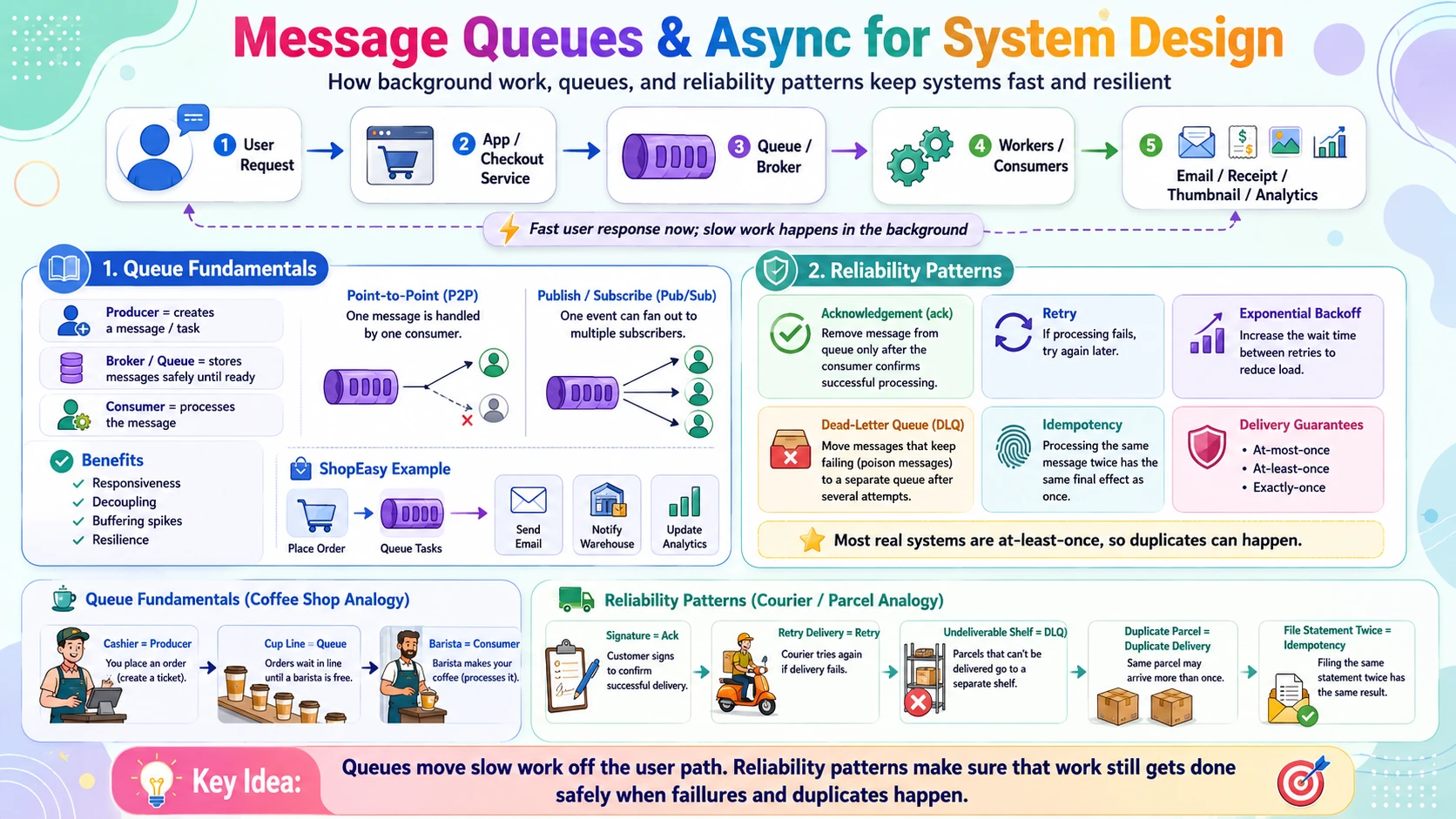
Not everything a system does needs to happen right now, while the user waits. Sending a confirmation email, generating a thumbnail, processing a payment receipt — these can happen a moment later, in the background, without making the user stare at a spinner. The tool that makes this possible is the message queue, and it's one of the most important building blocks for systems that stay fast and resilient under load. This post covers two sides of it. You will start with Queue Fundamentals — what a queue is, the producers that add work and consumers that process it, the broker in the middle, how messages flow, and how a point-to-point queue differs from publish/subscribe. Then you will learn about Reliability Patterns — how asynchronous processing, acknowledgements, retries, dead-letter queues, and delivery guarantees make sure work actually gets done even when things fail. Each topic is explained with real-world analogies, step-by-step examples, and clear diagrams — starting from zero.
📨 1. Queue Fundamentals
A message queue lets one part of your system hand off work to another part without waiting for it to finish. In this section you will learn the three roles in any queue — the producer that sends messages, the broker that stores them, and the consumer that processes them — how a message flows through the queue, why this decouples the pieces of a system, and the two core messaging shapes: a point-to-point queue where each message is handled once, and publish/subscribe where a message fans out to many subscribers.
1.1 🎯 Introduction
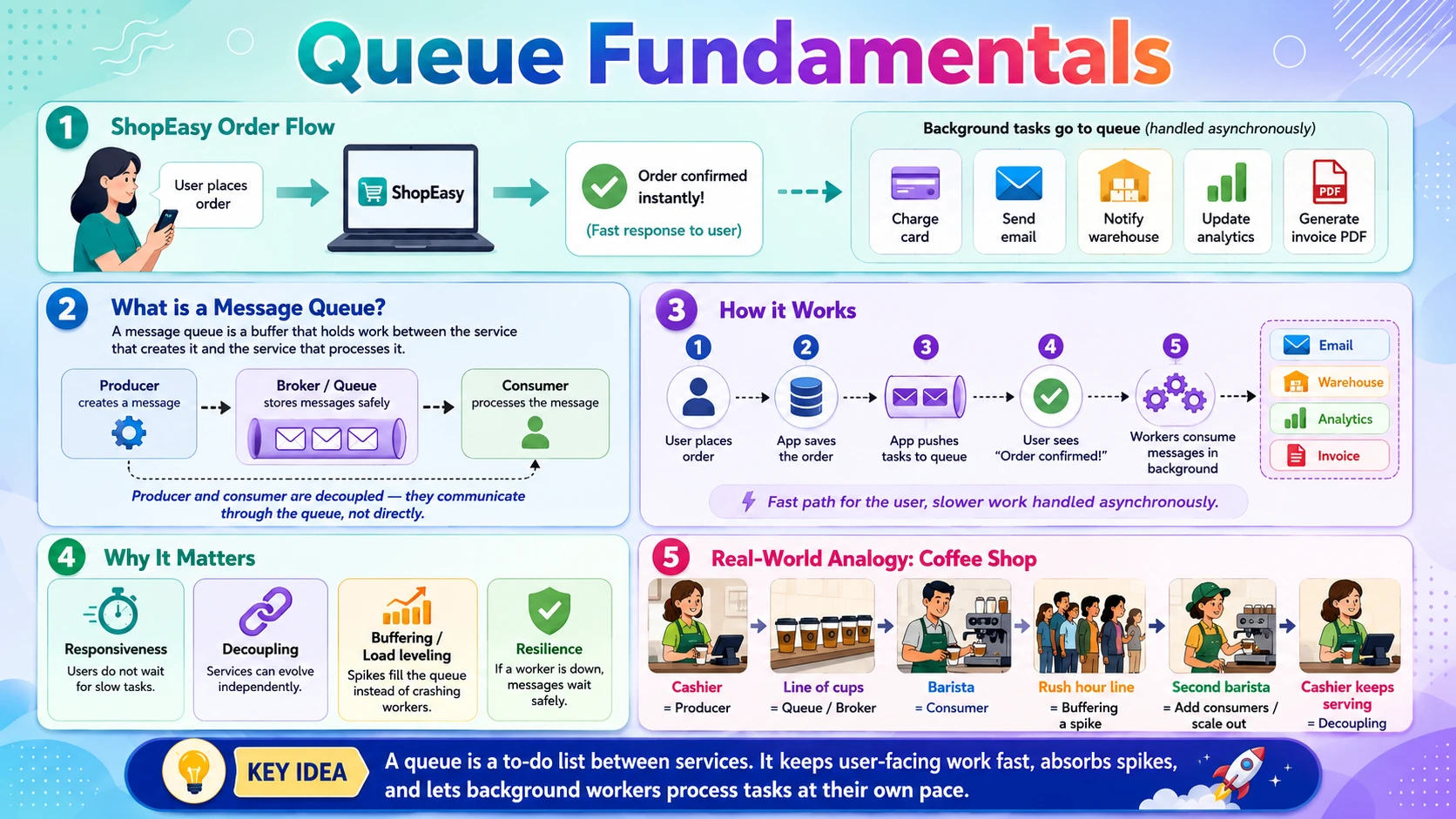
You place an order on our online store ShopEasy and instantly see "Order confirmed!". Behind that single click, a lot needs to happen: charge the card, send a confirmation email, notify the warehouse, update analytics, and generate an invoice PDF. If ShopEasy did all of that before showing you the confirmation, you'd stare at a spinner for ten seconds — and if the email service were slow, your order might fail for no good reason. Instead, ShopEasy saves the order, drops a few "please do this" notes into a message queue, and immediately confirms. The slow work happens moments later, in the background.
A message queue is a buffer that holds messages between the part of the system that creates work and the part that does it. Three roles are always involved:
- Producer — the component that creates a message and sends it (the checkout service adding a "send email" task).
- Broker (the queue) — the middle system that stores messages safely until someone is ready for them (RabbitMQ, Amazon SQS, Kafka).
- Consumer — the component that pulls a message and processes it (the email worker that actually sends the email).
The magic is that producers and consumers never talk to each other directly — they only talk to the queue. The producer drops a message and moves on; the consumer picks it up whenever it's ready. This separation is called decoupling, and it's the whole point of a queue.
💡 A queue is a to-do list between services. One service writes tasks onto the list and walks away; another service works through the list at its own pace. Neither has to wait for the other, and the list remembers the work even if a worker is briefly down.
1.2 💡 Why It Matters
Message queues are the backbone of large-scale systems, because they let services absorb spikes and fail independently instead of collapsing together. The scale is real: Uber and LinkedIn run Apache Kafka clusters moving trillions of messages per day; Amazon SQS routinely handles millions of messages per second for its customers. Whenever you get an email "a few seconds later," a video finishes processing "after upload," or a payment receipt arrives shortly after checkout, a queue is almost certainly involved.
- Responsiveness — the user waits only for the essential work; slow tasks move to the background, so pages feel instant.
- Decoupling — producers and consumers don't need to know about each other, run at the same time, or be written in the same language. You can change one side without touching the other.
- Load leveling (buffering) — a traffic spike fills the queue instead of crushing the workers; consumers drain it at a steady pace they can handle.
- Resilience — if a consumer crashes, messages wait safely in the queue and are processed when it recovers. Nothing is lost just because a worker was down.
Why system design cares: "put it on a queue" is the standard answer to slow work, spiky load, and tight coupling between services. Almost every design — order processing, notifications, video pipelines, analytics — uses a queue somewhere to keep the user-facing path fast and the system resilient.
1.3 🏠 Real-world Analogy
Think of a busy coffee shop. You order at the counter and the cashier writes your drink on a cup and places it in a line by the espresso machine. You don't stand at the counter blocking everyone while your latte is made — the cashier is free to take the next order immediately. The barista works through the cups in order, one at a time, at a steady pace. That line of cups is a message queue.
The cashier is the producer (creates orders), the cup line is the broker/queue (holds orders safely in order), and the barista is the consumer (processes each order). When a rush hits, the line simply gets longer — orders aren't lost, and the cashier keeps serving. If the shop gets a second barista, they both pull from the same line and drinks come out twice as fast. And nobody's coffee is forgotten just because one barista stepped away.
| Coffee Shop World | Queue World | Meaning |
|---|---|---|
| 🧾 Cashier taking orders | 📤 Producer | Creates work and hands it off |
| 🥤 Line of labelled cups | 📨 Queue (broker) | Holds messages safely, in order |
| ☕ Barista making drinks | 📥 Consumer | Processes one message at a time |
| 📈 A rush making the line longer | 🌊 Buffering a load spike | Work waits instead of overwhelming |
| 👥 Adding a second barista | ➕ Adding consumers | Scale throughput by processing in parallel |
| 🚶 Cashier free to keep serving | 🔗 Decoupling | Producer never waits for the consumer |
The reason coffee shops work this way is exactly the reason systems use queues: the fast step (taking orders) shouldn't be held hostage by the slow step (making drinks). Put a line between them and both run at their own comfortable speed.
1.4 📖 Key Terms
| Term | Simple Definition | Quick Example |
|---|---|---|
| Message | A small package of data describing a task or event | {"type":"send_email","order":1001} |
| Producer | The component that creates and sends messages | The checkout service |
| Consumer | The component that receives and processes messages | The email worker |
| Broker | The system that stores and routes messages | RabbitMQ, Amazon SQS, Kafka |
| Queue | An ordered buffer holding messages until consumed | The emails queue |
| Producer/Consumer | The pattern of one side making work, another doing it | Cashier and barista |
| Asynchronous | The producer doesn't wait for the work to finish | Confirm order, email later |
| Decoupling | Services interact only via the queue, not directly | Swap the email service freely |
| Pub/Sub | One message delivered to many subscribers | "Order placed" → email + analytics |
| Topic | A named channel subscribers listen to (pub/sub) | The order-events topic |
| FIFO | First-In-First-Out — messages kept in order | Process payments in sequence |
| Throughput | Messages processed per unit time | 50,000 messages/second |
1.5 🔢 How It Works
Let us break queues into four pieces: how a message flows from producer to consumer, why decoupling and buffering matter, how multiple consumers scale throughput, and the two core messaging shapes — point-to-point queues and publish/subscribe.
A. The Message Flow
A message is just a small, self-contained package of data — usually JSON — describing a task or an event. The producer builds it and sends it to the broker; the consumer later receives it and acts on it.
The end-to-end flow is always the same handful of steps:
| Step | What Happens |
|---|---|
| ① | The producer creates a message and sends it to the broker |
| ② | The broker stores the message in a queue (often on disk, so it survives a crash) |
| ③ | The producer gets a quick "received" and moves on — it does not wait for processing |
| ④ | A consumer asks the broker for the next message and receives it |
| ⑤ | The consumer processes the message (sends the email) |
| ⑥ | The consumer tells the broker "done" so the message is removed from the queue |
That final "done" signal — the acknowledgement — is what makes queues reliable; it's covered in depth in the next sub-topic. For now, notice steps ③ and ④ are decoupled in time: the message can sit in the queue for milliseconds or minutes before a consumer is ready.
B. Decoupling & Buffering
Because the producer and consumer only ever touch the queue, they're decoupled in three important ways. They can run at different times (the consumer can be down when the producer sends), at different speeds (a burst of messages just queues up), and be built with different technologies (a Python producer, a Go consumer). You can even add, remove, or rewrite either side without the other noticing.
The queue also acts as a shock absorber. Suppose ShopEasy normally creates 100 email tasks a minute, but a flash sale suddenly produces 10,000. Without a queue, the email service would be flooded and fall over. With a queue, those 10,000 messages simply wait in line, and the email workers drain them steadily at their own safe rate. The spike becomes a longer line, not a crash — this is called load leveling.
C. Scaling with Multiple Consumers
When one consumer can't keep up, you simply add more — all pulling from the same queue. The broker hands each message to one of the available consumers, so the work is shared. This is the competing consumers pattern, and it's how queues scale horizontally.
If the queue is growing faster than it's draining (a rising backlog), that's your signal to add consumers; when the backlog clears, you scale them back down. Because each message goes to exactly one consumer, doubling the consumers roughly doubles throughput — the same horizontal-scaling idea from the scalability post, applied to background work.
D. Queue vs Publish/Subscribe
There are two fundamental messaging shapes, and knowing the difference is essential:
- Point-to-point queue — each message is delivered to exactly one consumer. Perfect for tasks that should happen once: "process this payment," "resize this image." Competing consumers share the load, but any given message is handled by only one of them.
- Publish/subscribe (pub/sub) — each message is delivered to every interested subscriber. The producer publishes to a topic, and all subscribers get their own copy. Perfect for events that many parts of the system care about: one "order placed" event fans out to the email service, the analytics service, and the warehouse service at once.
| Aspect | Point-to-Point Queue | Publish/Subscribe |
|---|---|---|
| Delivery | Each message → one consumer | Each message → all subscribers |
| Purpose | Distribute tasks (do this once) | Broadcast events (tell everyone) |
| Analogy | Cups shared among baristas | A newsletter sent to all subscribers |
| Example tech | Amazon SQS, RabbitMQ queue | Amazon SNS, Kafka topics, Google Pub/Sub |
📌 One event, both shapes: real systems combine them. An "order placed" event is published (pub/sub) to several services; each service then puts its own work on a point-to-point queue for its workers to process once. Fan out with pub/sub, distribute work with queues.
1.6 🔀 Types & Variations
"Message queue" is an umbrella over a few different kinds of systems, each tuned for a different job. Knowing the categories helps you pick the right tool.
Message Broker
Classic queues: a message is consumed once and then removed. Great for task distribution.
- RabbitMQ, Amazon SQS, ActiveMQ
Log-based Streaming
Messages are appended to a durable log and kept after reading, so many consumers can replay them. Huge throughput.
- Apache Kafka, Amazon Kinesis, Pulsar
Pub/Sub Service
Broadcasts each event to all subscribers of a topic. Built for fan-out event notification.
- Amazon SNS, Google Pub/Sub, Azure Event Grid
Task Queue
App-level libraries for background jobs, built on top of a broker. Developer-friendly for "run this later".
- Celery (Python), Sidekiq (Ruby), BullMQ (Node)
Queue vs log — the key difference: a traditional broker deletes a message once it's consumed; a log-based system (Kafka) keeps it for a retention period, so different consumers can read the same stream independently and even re-read the past. Choose a broker for "do this task once," a log for "many systems process the same event stream."
1.7 🎨 Illustrated Diagram
The diagram shows ShopEasy's checkout as a producer. It publishes one "order placed" event that fans out (pub/sub) to two services, and the email service puts tasks on a point-to-point queue that several workers share.
Reading the diagram: the single event is copied to every subscriber (pub/sub fan-out), while each task in the email queue goes to only one worker (competing consumers). Add more workers and the queue drains faster; add more subscribers and each still gets its own copy of the event.
1.8 ✅ When to Use
Reach for a queue when work can happen later, when load is spiky, or when services should be loosely coupled. Skip it when the caller genuinely needs the result immediately.
| Use a queue when… | Skip the queue when… |
|---|---|
| Work can be done in the background (emails, thumbnails, invoices) | The caller needs the result right now to continue (a login check) |
| The task is slow and would block the user | The task is trivially fast and simplest done inline |
| Traffic is spiky and you want to buffer bursts | Load is steady and tiny, so buffering adds no value |
| Services should be decoupled and independently scalable | A simple, synchronous function call is clearer and enough |
| You need to retry failed work reliably (next sub-topic) | You need a strict, immediate transactional result |
And which shape to choose:
| If you need to… | Use |
|---|---|
| Run a task exactly once, shared across workers | Point-to-point queue (SQS, RabbitMQ) |
| Notify many services of the same event | Pub/sub (SNS, Google Pub/Sub) |
| Let many consumers process & replay a high-volume stream | Log-based streaming (Kafka, Kinesis) |
| Add simple background jobs to one app | Task queue (Celery, Sidekiq) |
Rule of thumb: if the user doesn't need the result to keep going, do it asynchronously through a queue. Keep the request path down to the essential work (save the order, take the payment) and push everything else — emails, receipts, analytics, thumbnails — onto a queue.
1.9 🏗️ Real-world Example — ShopEasy Checkout with a Queue
Alice clicks "Place order." Follow how a queue keeps her wait short while all the follow-up work still gets done:
| Step | Actor | What Happens |
|---|---|---|
| ① | 🛒 Checkout service | Saves the order and takes payment — the essential, synchronous work |
| ② | 📡 Checkout service (producer) | Publishes one order-placed event and instantly returns "Order confirmed!" to Alice |
| ③ | 📨 Broker | Fans the event out to the email, analytics, and warehouse services (pub/sub) |
| ④ | 📧 Email service | Enqueues a "send confirmation" task; a worker sends it a second later |
| ⑤ | 📦 Warehouse service | Enqueues a "pick & pack" task for the fulfilment workers |
| ⑥ | 📊 Analytics service | Records the sale for dashboards — completely independently |
| ⑦ | 🌊 Flash sale hits | 10,000 orders/min flood in; the queues absorb the surge and workers drain them steadily — no crash, no lost orders |
The payoff: Alice waited only for steps ① and ② (a fraction of a second). Everything else happened asynchronously. If the email service had been down, her order would still succeed and the email would send once the service recovered — the message waits safely in the queue. That resilience is the subject of the next sub-topic.
1.10 ⚖️ Trade-offs
Queues buy responsiveness, decoupling, and resilience — but they add a new piece of infrastructure and turn simple synchronous logic into distributed, asynchronous flows. The trade-offs:
| ✅ Advantages | ❌ Disadvantages |
|---|---|
| Responsiveness — users wait only for essential work | Added complexity — another system to run, monitor, and reason about |
| Decoupling — services evolve and scale independently | Eventual, not instant — background work completes a bit later |
| Load leveling — spikes queue up instead of crashing workers | Harder debugging — flows span producer, broker, and consumer |
| Resilience — work survives a consumer being down | Ordering & duplicates — many queues don't guarantee strict order or exactly-once |
| Scalability — add consumers to raise throughput | No result to the caller — you must report status another way |
📌 The core tension: a queue trades immediacy and simplicity for responsiveness, resilience, and scale. You give up "the answer right now, in one place" and gain a system that stays fast under load and doesn't fall apart when one piece fails — a trade that's almost always worth it for non-essential work.
1.11 🚫 Common Mistakes
| # | ❌ Common Mistake | ✅ The Reality |
|---|---|---|
| 1 | Queuing work the user is waiting on | If the caller needs the result to proceed, a queue just adds latency and complexity. Queue only work that can happen later. |
| 2 | Assuming strict ordering by default | Most standard queues don't guarantee order once you have multiple consumers. Use a FIFO queue or a partition key when order matters. |
| 3 | Expecting exactly-once delivery | Most queues deliver at least once, so duplicates happen. Make consumers idempotent (covered next sub-topic). |
| 4 | Ignoring the backlog | If producers outpace consumers, the queue grows without bound. Monitor queue depth and add consumers (or shed load) before it explodes. |
| 5 | Putting huge payloads in messages | Large blobs bloat the broker. Store the file in object storage and put just a reference (URL/ID) in the message. |
| 6 | Using a queue where pub/sub is needed (or vice versa) | A point-to-point queue delivers to one consumer; if many services need the event, use pub/sub. Match the shape to the need. |
1.12 📝 Summary
- A queue is a buffer between producer and consumer — one side creates work, the other processes it, via a broker in the middle.
- It decouples services — they run at different times, speeds, and technologies, and never call each other directly.
- It levels load — spikes fill the queue instead of crashing consumers, which drain it at a steady pace.
- Add consumers to scale — competing consumers share a queue; more workers means higher throughput.
- Queue vs pub/sub — a queue delivers each message to one consumer (do it once); pub/sub delivers to all subscribers (tell everyone).
1.13 🏋️ Design Challenge
🎥 Challenge: Design uploads for a video platform
Users upload videos that must be transcoded into several resolutions (slow!), a thumbnail generated, and subscribers notified. Uploads spike massively when a big creator posts. Think through the following:
- What should happen synchronously (while the user waits) versus on a queue?
- Transcoding is far slower than uploading. How does a queue stop slow transcoding from breaking uploads during a spike?
- Notifying subscribers, updating search, and updating analytics all care about "video ready." Which messaging shape fits — queue or pub/sub?
- Would you put the raw video file inside the message? Why or why not?
👁️ Show Answer
Sync vs async: synchronously, accept the upload (store the file) and return "upload received." Everything else — transcoding, thumbnailing, notifications — goes on a queue. The user should never wait minutes for transcoding.
Spike protection: upload requests just drop a "transcode this" task on a queue and finish fast. Transcoding workers drain the queue at their own rate, so a flood of uploads makes the queue longer — not the upload endpoint slower. Add more workers when the backlog grows (competing consumers).
Shape: use pub/sub for the "video ready" event — notifications, search indexing, and analytics each need their own copy. Each of those services can then use its own point-to-point queue for its workers. Fan out with pub/sub, distribute work with queues.
Payload: never put the raw video in the message — it could be gigabytes. Store the file in object storage and put only its URL/ID in the message. Workers fetch the file from storage when they process the task.
1.14 ☁️ Cloud Service Mapping
Every cloud offers managed messaging so you never run a broker yourself — a queue for tasks, a pub/sub service for events, and a streaming service for high-volume logs:
| Need | AWS (Primary) | GCP | Azure |
|---|---|---|---|
| Point-to-point queue — task distribution | Amazon SQS | Cloud Tasks | Azure Queue Storage / Service Bus |
| Pub/sub — fan-out events | Amazon SNS | Google Cloud Pub/Sub | Azure Event Grid / Service Bus topics |
| Streaming log — high-volume, replayable | Amazon Kinesis / MSK (Kafka) | Pub/Sub / Managed Kafka | Azure Event Hubs |
Simplest AWS picture: publish events to SNS, let each interested service subscribe with its own SQS queue (the "SNS fan-out to SQS" pattern), and run workers that drain those queues. For a high-volume, replayable event stream (clickstream, logs), reach for Kinesis or MSK instead. Fully managed — no broker to operate.
🛡️ 2. Reliability Patterns
A queue keeps your system fast — but fast is worthless if work silently disappears. What happens if a consumer crashes mid-task, or a message can never be processed, or the same message arrives twice? Reliability patterns answer these questions. In this section you will learn how asynchronous processing changes the reliability picture, how acknowledgements confirm a message was handled, how retries (with backoff) recover from transient failures, how a dead-letter queue quarantines messages that keep failing, the three delivery guarantees (at-most-once, at-least-once, exactly-once), and why idempotency is what makes at-least-once delivery safe.
2.1 🎯 Introduction
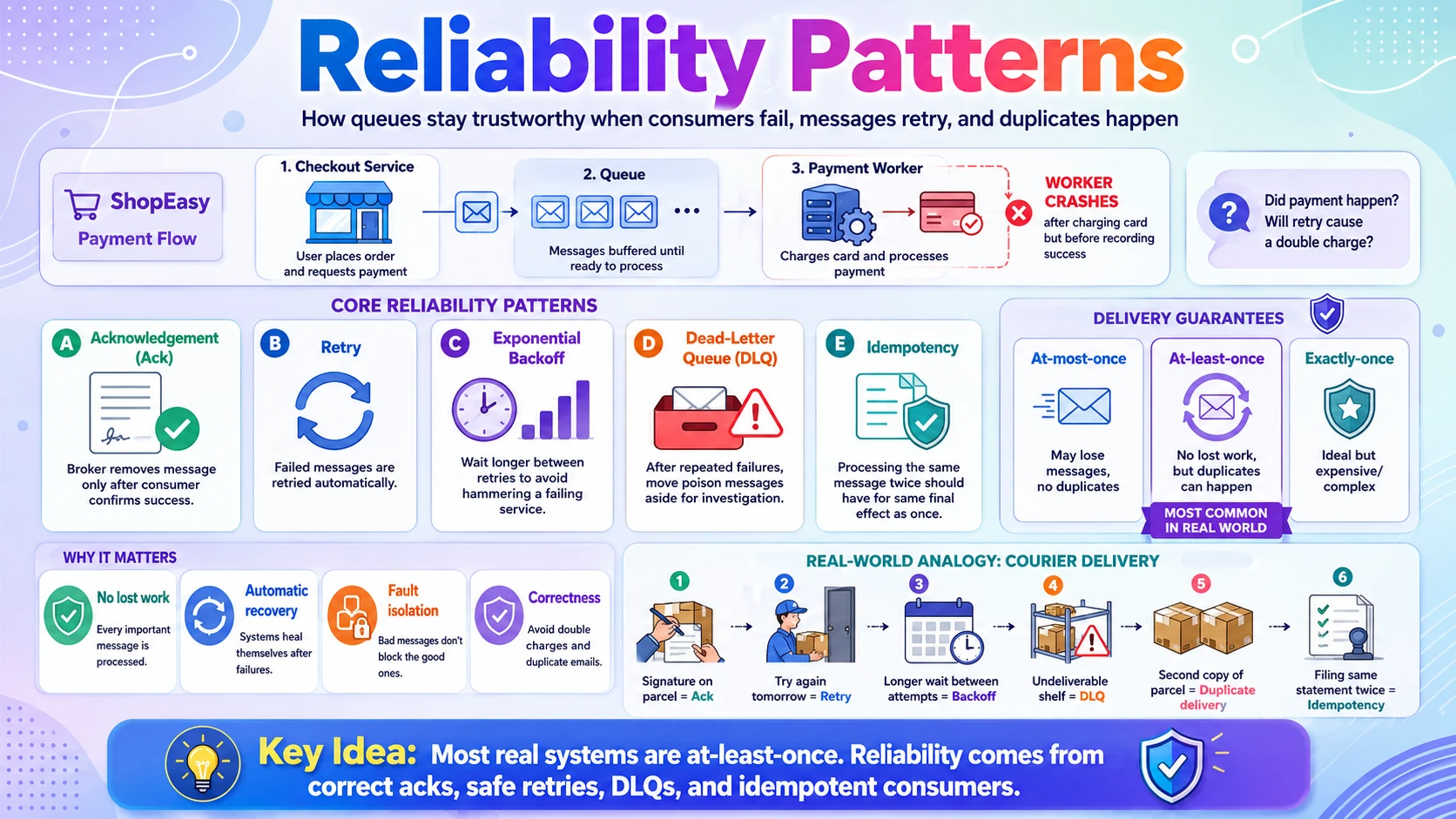
Back at ShopEasy, the checkout drops a "charge the card" message on a queue and a payment worker picks it up. Now imagine the worker crashes after charging the card but before recording success. Did the payment happen? Will it be retried and charge Alice twice? Or picture a malformed message the worker can never process — does it block the whole queue forever? A queue that just moves messages isn't enough; you need patterns that guarantee work actually completes, exactly the right number of times, even when things break.
Reliability patterns are the safeguards that make asynchronous messaging trustworthy. The core mechanism is the acknowledgement (ack): a consumer only tells the broker "done" once it has fully processed a message. Until that ack arrives, the broker keeps the message and will hand it out again — so a crashed consumer's work is never lost. Around that one idea sit the rest of the patterns:
- Retries — automatically re-deliver a message that failed, ideally with increasing delays (backoff).
- Dead-letter queue (DLQ) — after too many failures, move the "poison" message aside so it stops blocking others.
- Delivery guarantees — the promise of how many times a message is delivered: at-most-once, at-least-once, or exactly-once.
- Idempotency — designing a consumer so that processing the same message twice has the same effect as once.
💡 The golden rule of queues: most real systems deliver at least once, which means duplicates will happen. Reliability isn't about preventing every duplicate — it's about acknowledging correctly, retrying safely, quarantining poison messages, and making your processing idempotent so duplicates do no harm.
2.2 💡 Why It Matters
Reliability patterns are the difference between a queue that usually works and one you can trust with money and orders. The cost of getting them wrong is concrete: a missing acknowledgement can drop a customer's order; a naive retry can charge a card twice; a single poison message with no dead-letter queue can stall an entire pipeline and take a feature down for hours. At scale, "rare" failures are constant — a system processing a billion messages a day will see millions of retries, crashes, and duplicates, so these patterns run every second.
- No lost work — acknowledgements ensure a crashed consumer's message is redelivered, not silently dropped.
- Automatic recovery — retries with backoff ride out transient failures (a database blip, a rate-limited API) without human intervention.
- Fault isolation — a dead-letter queue stops one bad message from blocking every good one behind it.
- Correctness — understanding delivery guarantees and idempotency is what prevents double charges, duplicate emails, and double-shipped orders.
Why system design cares: when a design puts payments or orders on a queue, the immediate follow-up is "what if it's delivered twice, or the worker dies mid-way?" A strong answer names acks, retries with backoff, a DLQ, and idempotent consumers. These patterns are the reliability half of "just put it on a queue."
2.3 🏠 Real-world Analogy
Think of a courier delivering a parcel that needs a signature. The courier hands over the parcel and only marks the delivery complete once you sign for it — that signature is the acknowledgement. If nobody's home (the delivery fails), the courier doesn't throw the parcel away; they try again tomorrow, and the day after — that's a retry. But they don't try forever: after three failed attempts, the parcel goes back to the depot's "undeliverable" shelf for someone to investigate — that shelf is the dead-letter queue.
Now the tricky part. Suppose the courier delivered your parcel but their scanner failed to record the signature. The system thinks it failed, so tomorrow a second parcel arrives — a duplicate delivery. If the parcel is a statement you just file, no harm: opening it twice changes nothing. That "handling it twice is the same as once" property is idempotency, and it's what makes the retry-happy courier system safe.
| Courier World | Messaging World | Meaning |
|---|---|---|
| ✍️ You signing for the parcel | ✅ Acknowledgement (ack) | Confirms the message was fully handled |
| 🔁 Trying again tomorrow | ♻️ Retry | Re-deliver after a transient failure |
| 📅 Waiting longer between attempts | ⏳ Exponential backoff | Increasing delay between retries |
| 📦 The depot's "undeliverable" shelf | ☠️ Dead-letter queue | Quarantine for messages that keep failing |
| 📬 A second copy of the same parcel | 👯 Duplicate delivery | At-least-once means duplicates happen |
| 🗂️ Filing a statement twice = same result | 🔒 Idempotency | Reprocessing does no extra harm |
A good courier service never loses a parcel, retries sensibly, sets aside the ones it truly can't deliver, and copes gracefully with the occasional duplicate. Every reliability pattern in this section is one of those courier habits applied to messages.
2.4 📖 Key Terms
| Term | Simple Definition | Quick Example |
|---|---|---|
| Acknowledgement (ack) | Consumer's signal that a message was processed | Worker acks after sending the email |
| Negative ack (nack) | Signal that processing failed; re-queue it | Worker nacks on a DB error |
| Visibility timeout | Time a message is hidden while being processed | SQS hides it for 30s |
| Retry | Re-delivering a message after a failure | Try again after a timeout |
| Exponential backoff | Increasing wait between retries | 1s, 2s, 4s, 8s… |
| Dead-letter queue (DLQ) | Holding area for messages that keep failing | Move after 5 attempts |
| Poison message | A message that can never be processed | Malformed JSON payload |
| At-most-once | Delivered 0 or 1 time — may be lost, never duplicated | Fire-and-forget metrics |
| At-least-once | Delivered 1+ times — never lost, may duplicate | The common default |
| Exactly-once | Delivered and processed precisely once | Hardest; needs extra work |
| Idempotency | Reprocessing gives the same result as once | "Set status = paid" |
| Idempotency key | A unique ID used to detect duplicates | Skip if order:1001 already done |
2.5 🔢 How It Works
Let us build reliability up one layer at a time: acknowledgements (so nothing is lost), retries with backoff (to recover from failures), dead-letter queues (to isolate poison messages), the three delivery guarantees (what the system promises), and idempotency (what makes it all safe).
A. Acknowledgements & Visibility Timeout
The acknowledgement is the foundation. When a consumer takes a message, the broker doesn't delete it — it hides it from other consumers for a window called the visibility timeout. The consumer processes the message, then sends an ack, and only then does the broker delete it. If the consumer crashes before acking, the timeout expires, the message reappears, and another consumer picks it up. Nothing is lost.
The visibility timeout must be longer than the work takes. Set it too short and the broker thinks the consumer died and redelivers while the first consumer is still working — creating a duplicate. This is one reason duplicates are normal, and why idempotency (below) matters.
B. Retries & Exponential Backoff
Many failures are transient — a database hiccup, a rate-limited third-party API, a brief network blip. The fix is simply to try again. But retrying immediately and forever is dangerous: if a downstream service is overloaded, a storm of instant retries makes it worse. So retries use exponential backoff: wait a little, then double the wait each time.
Adding a little randomness (jitter) to each delay stops thousands of consumers from retrying in lockstep and hammering the service at the same instant. Backoff gives the struggling downstream time to recover instead of piling on.
C. Dead-Letter Queues
Some messages will never succeed — a malformed payload, a reference to a deleted record, a bug. These are poison messages, and retrying them forever wastes resources and can block everything behind them. After a message exceeds its maximum retries, the broker moves it to a dead-letter queue (DLQ): a separate queue for failed messages.
The DLQ does two jobs. It unblocks the main queue so good messages keep flowing, and it preserves the failures for humans to inspect, fix, and optionally replay. Teams alert on DLQ depth — a rising DLQ is an early warning that something is broken. Without a DLQ, one poison message can stall an entire pipeline.
D. Delivery Guarantees
Every messaging system makes one of three promises about how many times a message is delivered. This is one of the most important concepts in messaging:
| Guarantee | Promise | Use when… |
|---|---|---|
| At-most-once | Delivered 0 or 1 time — may be lost, never duplicated | Loss is acceptable: metrics, non-critical logs |
| At-least-once | Delivered 1 or more times — never lost, may duplicate | The common default: emails, tasks, orders (with idempotency) |
| Exactly-once | Delivered and processed precisely once | Strict correctness: some financial flows |
The catch: true exactly-once is very hard and expensive in a distributed system — it requires coordination the network fights against. So most systems choose at-least-once (never lose a message) and then make the consumer idempotent to neutralise the duplicates. In practice, "at-least-once delivery + idempotent processing = effectively exactly-once effect," which is what you actually care about.
E. Idempotency — The Safety Net
Idempotency means processing the same message twice has the same effect as processing it once. Since at-least-once delivery guarantees duplicates will eventually happen, idempotent consumers are what keep those duplicates harmless — no double charges, no double emails.
The usual technique is an idempotency key: give each message a unique ID, and record which IDs you've already processed. Before doing the work, check whether you've seen this ID; if so, skip it.
Some operations are naturally idempotent and need no key: "set status to paid" or "set quantity to 3" give the same result no matter how many times you run them. Operations like "add $10" or "increment count" are not — those need an idempotency key to stay safe under retries.
📌 The reliability recipe: acknowledge only after success, retry transient failures with exponential backoff, send repeat offenders to a dead-letter queue, accept at-least-once delivery, and make consumers idempotent. Together these give you a system that loses nothing and double-charges no one.
2.6 🔀 Types & Variations
Beyond acks and retries, a handful of named patterns show up again and again in reliable async systems. Here are the ones worth knowing.
Idempotent Consumer
Track processed message IDs (idempotency keys) so a duplicate is detected and skipped. The standard partner to at-least-once delivery.
Dead-Letter Queue
Route messages that exceed max retries to a separate queue, so poison messages are isolated for inspection instead of blocking the pipeline.
Circuit Breaker
When a downstream keeps failing, stop calling it for a while instead of hammering it with retries — giving it room to recover.
Transactional Outbox
Write the message to a DB table in the same transaction as your data, then publish it separately — so a save and its event never drift apart.
How they fit together: retries with backoff handle transient failures, a circuit breaker handles a sustained downstream outage, a dead-letter queue handles permanent (poison) failures, and the idempotent consumer + outbox keep everything correct despite duplicates. Each targets a different kind of failure.
2.7 🎨 Illustrated Diagram
The diagram shows a message's reliable lifecycle. A consumer processes it; success acks and deletes it; failure retries with backoff; and after too many failures it lands in the dead-letter queue for a human to inspect.
Reading the diagram: the happy path is receive → success → ack. A transient failure loops back through retry-with-backoff, giving the downstream time to recover. Only after repeated failures does the message leave the loop for the dead-letter queue — so one poison message never blocks the rest.
2.8 ✅ When to Use
These patterns aren't all-or-nothing — you dial them up based on how much a lost or duplicated message would hurt. Match the guarantee to the stakes.
| Situation | Reach for… |
|---|---|
| Any work you can't afford to lose (orders, payments, emails) | Manual acks + at-least-once delivery |
| Failures that are usually transient (flaky API, DB blip) | Retries with exponential backoff + jitter |
| A downstream that's fully down, not just flaky | Circuit breaker — stop retrying for a while |
| Messages that can never succeed (poison/malformed) | Dead-letter queue + alerting |
| At-least-once delivery (so duplicates can occur) | Idempotent consumers (idempotency keys) |
| High-volume data where the odd loss is fine | At-most-once — skip acks for speed |
| Invest in strong reliability when… | Keep it light when… |
|---|---|
| The message represents money, an order, or a legal record | The data is disposable (sampled metrics, debug logs) |
| Losing or duplicating work is user-visible or costly | A missed message simply means one gap in a chart |
| Downstream services fail intermittently | The consumer is trivial and always succeeds fast |
Rule of thumb: default to at-least-once + idempotent consumers + a dead-letter queue — it's the sweet spot that never loses work and stays correct under duplicates. Only drop to at-most-once for truly disposable data, and only chase true exactly-once when the cost of a single duplicate is genuinely unacceptable.
2.9 🏗️ Real-world Example — ShopEasy Payment Worker Survives a Crash
A "charge card" message flows to ShopEasy's payment worker. Watch every reliability pattern kick in as things go wrong — and the customer is still charged exactly once:
| Step | Event | Pattern at work |
|---|---|---|
| ① | Worker receives charge order 1001; broker hides it (visibility timeout) | 🔒 Message not deleted until acked |
| ② | The payment gateway is briefly rate-limited → the charge fails | ♻️ Retry with backoff (wait 1s, 2s, 4s…) |
| ③ | Retry succeeds — the card is charged | ✅ Transient failure absorbed |
| ④ | Worker crashes before it can ack; timeout expires; message reappears | 🛡️ No lost work — redelivered to another worker |
| ⑤ | New worker sees order:1001 already in the processed store → skips the charge | 🔑 Idempotency prevents a double charge |
| ⑥ | New worker acks the message; broker deletes it | ✅ Exactly-once effect achieved |
| ⑦ | A different message has a corrupt payload; fails 5 times → moved aside | ☠️ Dead-letter queue + alert for a human |
The payoff: despite a rate-limit and a mid-task crash, order 1001 was charged exactly once and nothing was lost — thanks to acks, retries, and idempotency working together. Meanwhile a poison message was quarantined without stalling the queue. This is what "reliable async" actually looks like in production.
2.10 ⚖️ Trade-offs
Reliability isn't free — every guarantee adds work, latency, or complexity. The trade-offs of building a robust async pipeline:
| ✅ Advantages | ❌ Costs |
|---|---|
| No lost work — acks + at-least-once guarantee delivery | Duplicates — at-least-once means you must handle them |
| Automatic recovery — retries ride out transient failures | Added latency — backoff delays a message's completion |
| Fault isolation — DLQ stops poison messages blocking the queue | More components — DLQs, dedupe stores, monitoring to run |
| Correctness — idempotency neutralises duplicates | Design effort — idempotency keys and dedupe logic to build |
| Tunable — pick the guarantee level per workload | Exactly-once is expensive — heavy coordination, real overhead |
📌 The core tension: stronger guarantees cost more work and latency. The pragmatic sweet spot almost everyone lands on is at-least-once + idempotency: it never loses a message, it's far cheaper than true exactly-once, and idempotent consumers make the inevitable duplicates harmless.
2.11 🚫 Common Mistakes
| # | ❌ Common Mistake | ✅ The Reality |
|---|---|---|
| 1 | Acking before the work is done | Acking on receipt (auto-ack) means a crash loses the message. Ack only after processing succeeds. |
| 2 | Assuming exactly-once by default | Almost all systems are at-least-once, so duplicates happen. Design idempotent consumers rather than assuming they won't. |
| 3 | Retrying immediately and forever | Instant, endless retries hammer a struggling downstream and can cause a retry storm. Use exponential backoff, jitter, and a max-retry cap. |
| 4 | No dead-letter queue | Without a DLQ, one poison message retries forever and can block the pipeline. Route repeat failures to a DLQ and alert. |
| 5 | Ignoring the dead-letter queue | A DLQ nobody watches just hides failures. Monitor its depth and investigate — a growing DLQ means something is broken. |
| 6 | Retrying non-transient errors | Retrying a malformed payload or a validation error never helps. Retry only transient failures; send permanent ones straight to the DLQ. |
2.12 📝 Summary
- Acknowledgements prevent lost work — the broker keeps a message until the consumer confirms success; a crash means redelivery, not loss.
- Retries with backoff recover transient failures — wait longer each attempt (plus jitter) so a struggling downstream can recover.
- Dead-letter queues isolate poison messages — repeat failures move aside for inspection instead of blocking the pipeline.
- Three delivery guarantees — at-most-once (may lose), at-least-once (may duplicate, the default), exactly-once (hard and costly).
- At-least-once + idempotency is the sweet spot — never lose a message, and make duplicates harmless with idempotency keys.
2.13 🏋️ Design Challenge
💳 Challenge: Make a payment pipeline bulletproof
A payments service consumes "charge customer" messages from a queue and calls an external card processor. It must never lose a charge and never double-charge. Think through the following:
- When should the consumer acknowledge the message — and why does the timing matter?
- The card processor is briefly down. How do you retry without making things worse?
- The queue is at-least-once, so a charge message may arrive twice. How do you guarantee the customer is charged only once?
- A few messages reference deleted accounts and can never succeed. What happens to them?
👁️ Show Answer
Ack timing: acknowledge only after the charge is confirmed and recorded — never on receipt. That way, if the worker crashes mid-charge, the message reappears and is retried instead of being silently lost.
Processor down: retry with exponential backoff and jitter (1s, 2s, 4s…), and cap the attempts. Add a circuit breaker: if the processor is failing consistently, stop calling it for a cool-off period rather than flooding it with retries.
No double charge: make the consumer idempotent. Attach an idempotency key to each charge (e.g. the order ID); before charging, check whether that key was already processed and skip if so. Most card processors also accept an idempotency key on their API, giving a second layer of protection. Result: at-least-once delivery, but exactly-once effect.
Impossible messages: those are poison messages. After the retry cap, route them to a dead-letter queue and alert the team, so they stop wasting retries and don't block valid charges — while preserving them for investigation.
2.14 ☁️ Cloud Service Mapping
The reliability patterns are built into managed queues — you configure them rather than code them from scratch:
| Reliability feature | AWS (Primary) | GCP | Azure |
|---|---|---|---|
| Acks & retries — visibility timeout / redelivery | SQS visibility timeout | Pub/Sub ack deadline | Service Bus peek-lock |
| Dead-letter queue — quarantine failures | SQS redrive → DLQ | Pub/Sub dead-letter topic | Service Bus dead-letter sub-queue |
| Ordering & dedup — near exactly-once | SQS FIFO queues | Pub/Sub ordering keys + exactly-once | Service Bus sessions + dedup |
Simplest AWS picture: use SQS with a sensible visibility timeout, attach a dead-letter queue with a max-receive count (say 5), and make your consumers idempotent. For strict ordering and de-duplication, switch to an SQS FIFO queue. The platform handles redelivery, backoff, and DLQ routing — you supply the idempotency.
📚 References
- System Design Interview (Vol. 1 & 2) — Alex Xu — Uses queues, async workers, and retries as core building blocks; includes a distributed message queue design.
- Designing Data-Intensive Applications — Martin Kleppmann — Deep coverage of messaging, delivery semantics, and idempotency in distributed systems.
- Enterprise Integration Patterns — Hohpe & Woolf — The canonical catalogue of messaging patterns (dead-letter channel, competing consumers, and more).
- AWS SQS & SNS Developer Guides — Practical references for visibility timeouts, dead-letter queues, and fan-out patterns.
- Apache Kafka Documentation — Delivery semantics, consumer groups, and exactly-once processing at scale.